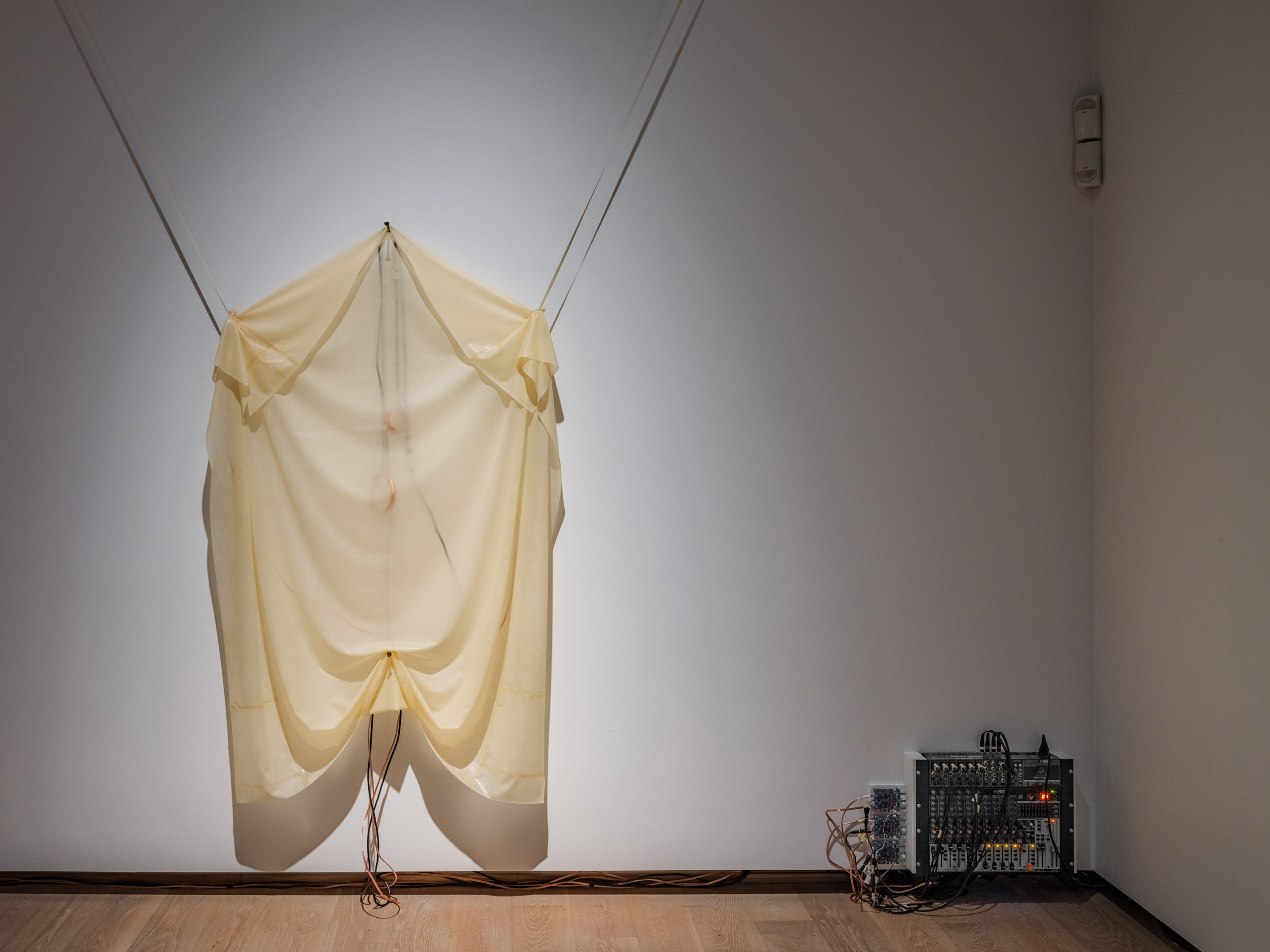
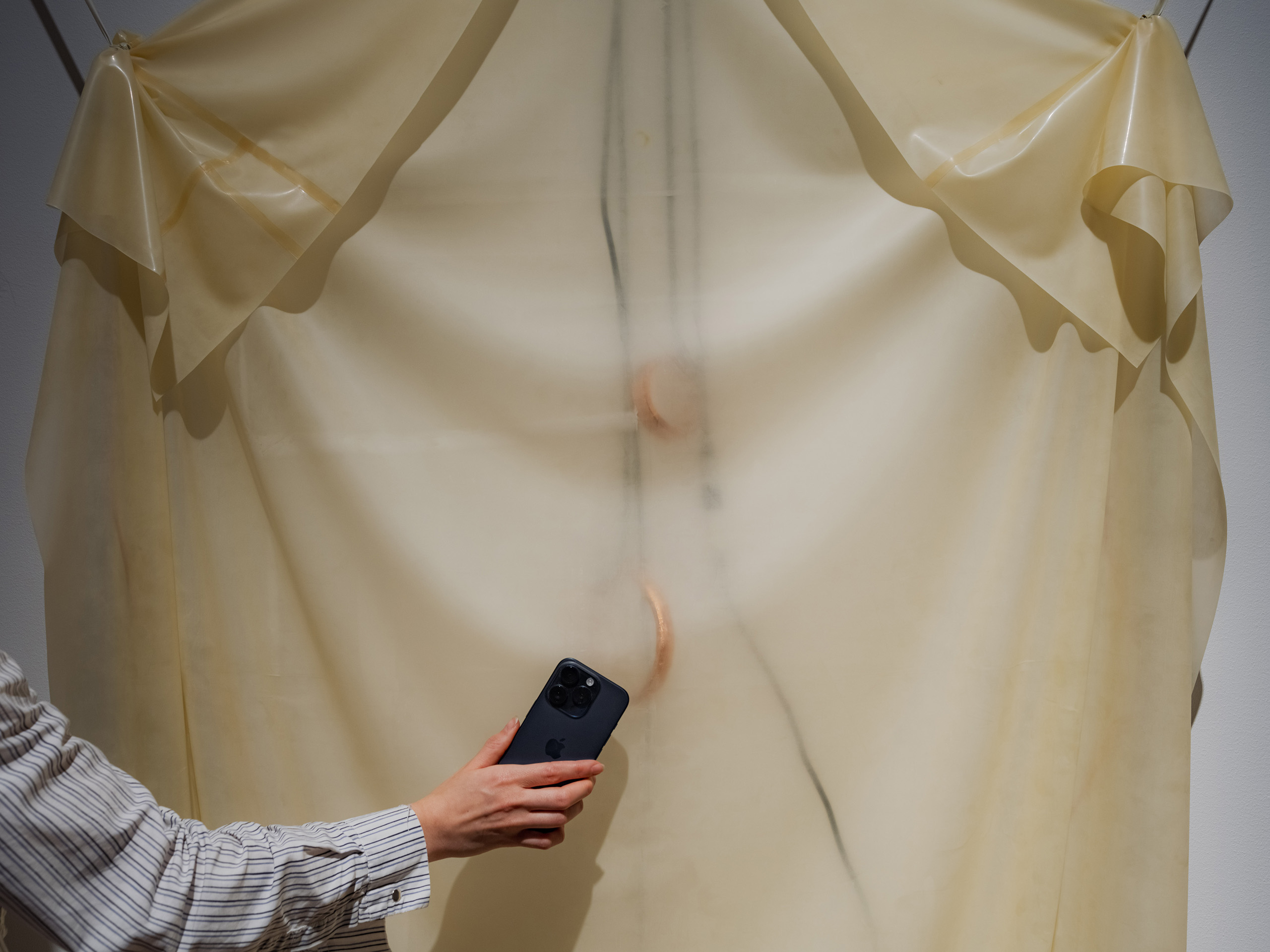
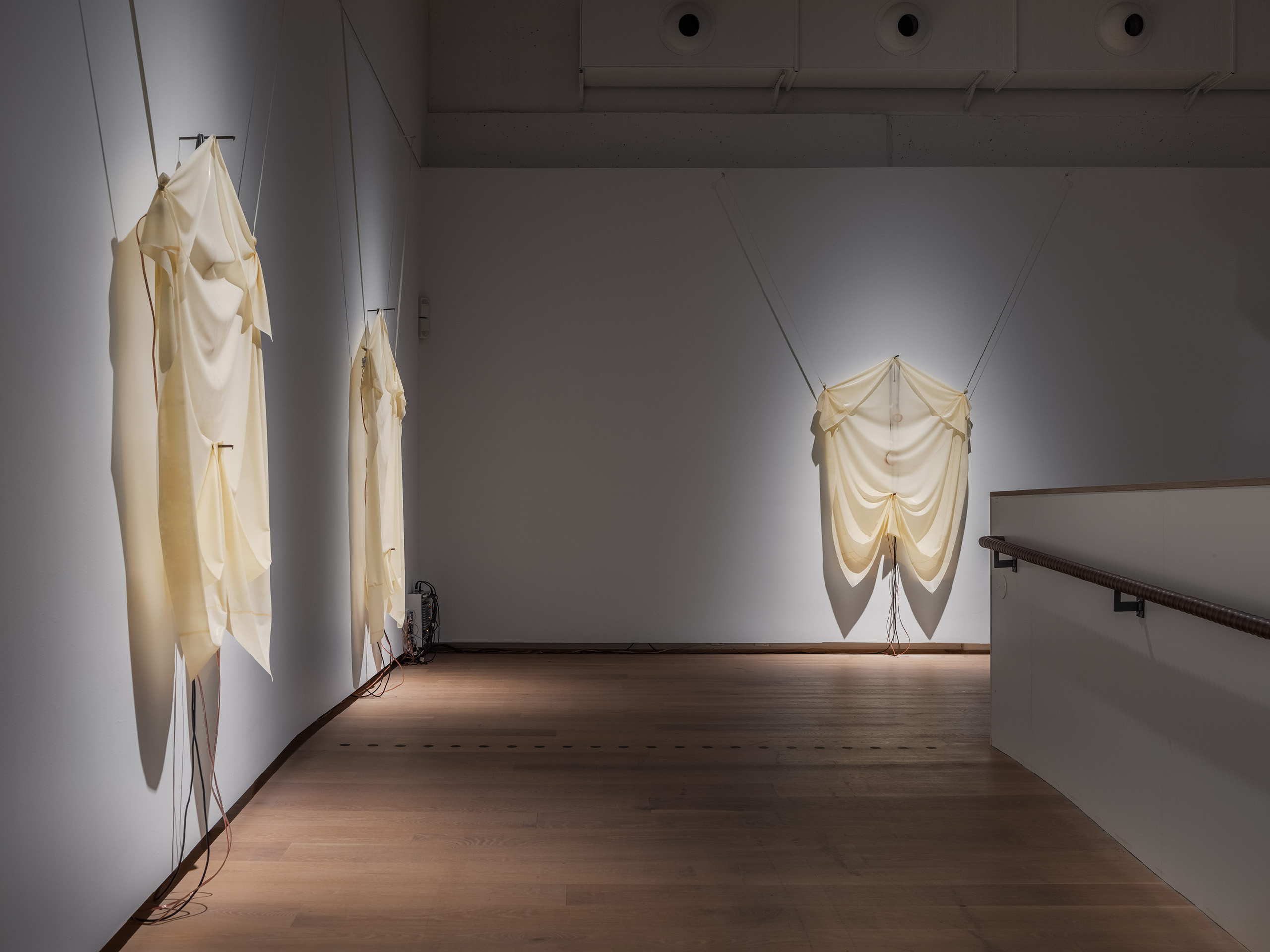
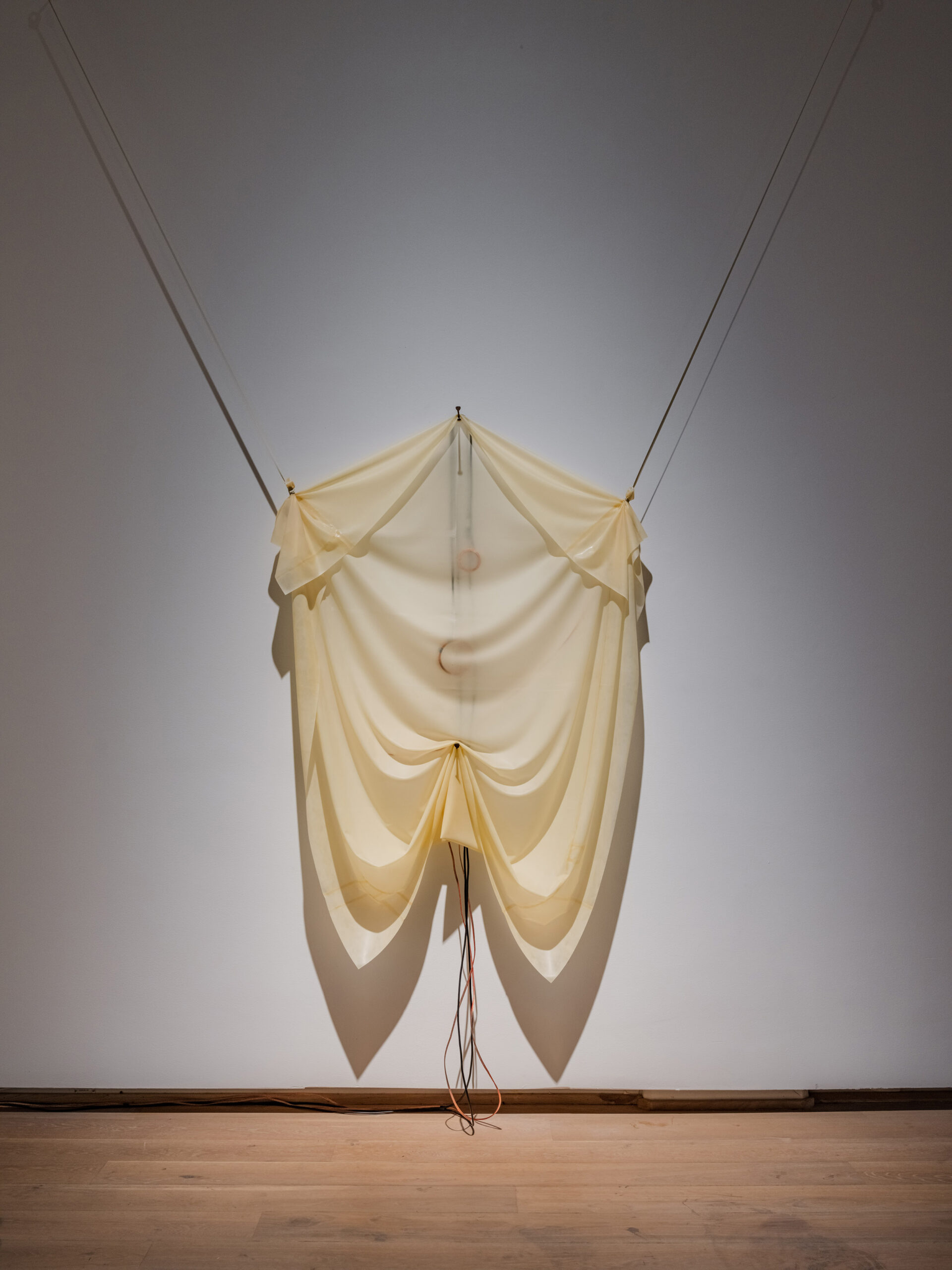
‘Veronicas: ”. . . All those I might have helped (Pause.) Helped! (Pause.) Saved. (Pause.) Saved! (Pause.) The place was crawling with them (Pause. Violently.) Use your head, can’t you, use your head, you’re on earth, there’s no cure for that! (Pause.) Get out of here and love one another! Lick your neighbor as yourself! (Pause. Calmer.) . . . ” I-III’, “Vera Was Here”, Accelerator, Stockholm, Sweden, 2025, Natural latex, grommets, exciters, copper coil electromagnetic frequency generators, speaker cable, XLR cables, mixer.
Vera Was Here, Accelerator, Sweden, September 13, 2025–February 8, 2026
Knox’s new series of works draws from an interest in mythopoeia (myth-making) and imprints of experience, taking inspiration from the iconography of Veronica, the Christian patron saint of laundry and photography. In the extra-biblical medieval telling, Veronica offers Jesus a cloth (the ‘Sudarium’) to wipe his face on his way to be crucified. Once returned, she finds that residual blood, sweat, tears and dirt have been miraculously transformed into an image of Jesus’ face (the ‘Vera Icon’). Veronica is likely an amalgamation of another biblical figure, the ‘Haemorrhoissa’, who is said to have been cured of chronic uterine haemorrhaging by touching the hem of Jesus’ cloak. Knox’s exploration into the ways in which materials carry (energetic) information developed from research into intermediate zones—points of contact and slippage between the internal and external, and what remains in transiting between them.
At Accelerator, Knox borrows from Francisco de Zurburan’s series of Veils of Saint Veronica (1635–1640), one of which is exhibited at the National Museum in Stockholm. Here, she reinterprets them in natural latex—made from the fluid exuded by a rubber plant upon injury, and a material prevalently used in erotic fetish-wear—to create a portrait of electromagnetic fields produced by the exhibition space and all bodies within it. Instead of a face emerging from the veil, copper coils appear, which continuously receive and emit the room’s usually inaudible electromagnetic hum. Knox connects organic traces in religious iconophilia to the digital traces of the mobile phones we carry with us, which constantly transmit and store memories, relationships, secrets and voices via radio frequencies—a type of electromagnetic radiation. Tracing the energetic exchange that occurs between architecture, artworks and visitors, Knox also nods to Accelerator’s history as a Physics laboratory.
The title of the work is taken from the play ‘Endgame’ by the Irish playwright Samuel Beckett, who frequently employed the Veil of Saint Veronica as a dramaturgical device to disrupt the representation of authority figures, and to symbolically allude to the unstable nature of memory. It is meant to be read aloud, with dramatic intention.